
Start with the area, not a material recommendation
If you are comparing facial contour implants in Korea, first identify the area you want assessed: the forehead, the area beside the nose or the chin. A flat-looking contour is a description of a concern, not a diagnosis or evidence that you need an implant. Your anatomy and goals must be assessed in person.
DI’s published facial-contour implant overview discusses these three areas. This article helps organize questions about the proposed material and treatment plan; it does not recommend a particular device or operation. Suitability, expected effects, price and recovery require individual clinical evaluation.
Separate augmentation from reduction or lifting
An augmentation discussion concerns adding contour. That is not the same as removing bone, removing fat or lifting soft tissue. Ask the surgeon to explain which structure contributes to your concern and what the proposed procedure would leave unchanged. An implant should not be presented as a universal answer to facial imbalance.
For the chin, distinguish an implant discussion from DI’s separate bone-contouring page. A bite or broader jaw concern may require a different assessment. Forehead augmentation is also different from moving the hairline in forehead reduction. If additional procedures are proposed, ask for a separate purpose, risk discussion and cost for each.
Request the exact material and device details
DI describes individually fitted implants on its overview, but that description alone does not establish the manufacturer, product, material, dimensions or regulatory status of a device for your plan. Ask for those details before consenting. Do not infer a specific material from the word customized or from a photograph.
Ask why the proposed material and fit are appropriate for the intended area, how it would be positioned and how the plan accounts for existing asymmetry and tissue coverage. Clarify whether individually fitted means selecting a size, modifying a shape or another process. Request an explanation of alternatives and the limits of any planning images.
Keep your own tissue distinct from a manufactured implant
For paranasal augmentation, DI’s page also discusses the patient’s own rib cartilage as an option instead of an implant. These are different material choices. If your own tissue is proposed, ask where it would be obtained, why it is being considered and what additional donor-site care and risks it adds.
The same page mentions possible combined rhinoplasty. That does not mean rhinoplasty is necessary for a paranasal concern or that a combined procedure has the same recovery as an isolated implant. Ask whether the concern relates to contour, dental relationships or another issue, and whether a separate assessment is needed.
Ask where the incision would be and what follows from it
DI discusses scalp access for forehead implants and an inside-mouth incision for chin implants. Ask the treating surgeon to map the actual incision proposed for you and explain its healing and care requirements. A less visible location does not mean that surgery is scar-free or that wound problems cannot occur.
Confirm how the implant would be secured and monitored, whether sutures or dressings need attention, and which activities could put pressure on the area. Prior implants, surgery, fillers or threads should be disclosed through the clinic’s designated clinical process. Do not treat an online animation as an operative plan.
Include implant-specific problems in the risk discussion
The American Society of Plastic Surgeons lists implant movement, infection, altered sensation, persistent pain, contour irregularity, unfavorable scarring and possible revision among facial-implant risks. Bleeding, anesthesia risks and damage to deeper structures also need discussion. This is not a complete list or your personal risk estimate.
Ask how an unexpected change would be assessed, who provides urgent care and what further treatment might involve. If removal or replacement becomes necessary, ask how that would affect contour, cost and follow-up. Avoid promises that a material lasts forever, is risk-free or can always be removed without consequences.

Obtain care instructions for the actual treatment area
DI’s overview includes general facial-contouring aftercare, covering washing, swelling, mouth care and activity. Not every instruction on a category page applies to every implant. Ask for written instructions specific to your incision, dressing and treatment area instead of copying a mouthwash recipe or activity date.
ASPS emphasizes individualized wound care and follow-up. Confirm when to return, whether any sutures need removal, and when work, exercise or travel may be appropriate. A short initial-recovery estimate on a website is not a final-healing date or clearance to fly.
ASPS: individual care and review questions after facial implants
Read the original chin-implant case within its limits
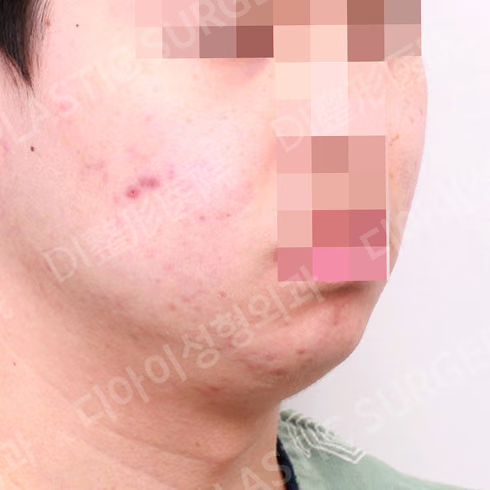
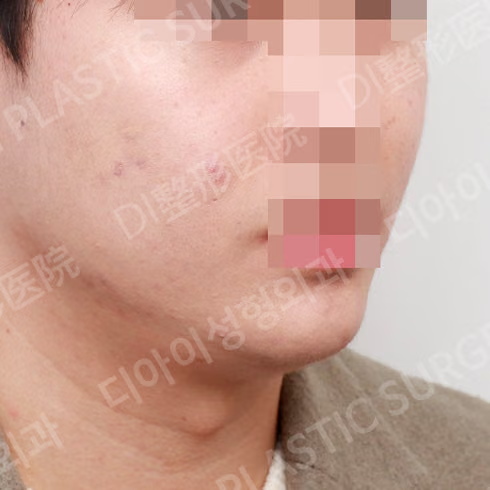
The unchanged pair below is designated DI gallery case 130, labelled Chin implant, 45°, 1 month after surgery. Chin implantation is one of the procedures discussed in this guide; the pair is not a forehead or paranasal implant case. The gallery does not identify its material, manufacturer or exact operative technique, so none is inferred.
The displayed timing is a relative postoperative interval, not a calendar capture date or proof of complete healing. Results and recovery vary, and this individual case cannot predict your appearance. Original composition, watermark and privacy masking are retained without cropping, generated edits or new overlays. All other explanatory images in this article are AI-generated, not patient evidence.
Find Chin implant case 130 in the designated original gallery
Leave with a material record and a follow-up plan
Before deciding, ask for an itemized estimate and a clear plan covering the exact procedure, material, anesthesia, risks, alternatives and reviews. Clarify what records you would receive about any implanted device and how later clinicians could obtain the relevant operative details. A consultation may lead to an alternative, postponement or no operation.
For an initial overseas inquiry, state your concern, preferred language and tentative Seoul dates without sending sensitive records through a general contact form. Ask which visits must occur locally and how concerns would be handled after returning home. The clinical team, not a generic travel timetable, sets your care plan.
Information that helps us prepare a useful reply
When contacting the clinic, tell us the procedure or concern you would like to discuss, your preferred language, whether you have had related treatment before and the dates you could visit Seoul. International patients may also wish to include their arrival and departure dates so the team can explain when an in-person consultation and follow-up may fit into the trip.
Please do not send passport numbers, payment information or complete medical records through an initial website inquiry. A coordinator can explain which health information or photographs are relevant and how they should be shared. Online guidance is preliminary; suitability, technique and the final treatment plan are determined only after an appropriate medical assessment.
 Before
 After
After