
Begin with the hairline change you want to discuss
If you are researching forehead reduction in Korea, a useful first question is how your hairline relates to the concern you want assessed. Describe whether the concern is forehead height, the shape of the frontal hairline or the balance of the face in front and profile views. A photograph alone cannot establish which operation, if any, is suitable.
DI’s published forehead-reduction page discusses hairline refinement and forehead proportions. This guide focuses on questions about hairline planning and the incision, rather than promising a particular reduction. Suitability, expected effects, price and recovery all require individual evaluation.
Read DI’s published forehead-reduction overview and aftercare
Clarify the difference between reduction and a forehead lift
The name forehead reduction can be used differently across surgical discussions. Ask your surgeon to identify the structure being changed and the intended endpoint in plain language. Do not assume that a discussion about forehead contour automatically means work on the forehead bone. DI’s page describes hairline-related planning; the exact operation must still be confirmed.
A forehead or brow lift addresses a different set of questions, including brow position. The two procedures should not be treated as interchangeable, even when a clinic discusses them together. If a combined plan is proposed, ask what each component would change, what it would leave unchanged and what extra risks or follow-up it adds.
Compare DI’s separate forehead-lift procedure information
Prepare separate questions about brow position and hairline access
Ask about hairline stability and scalp assessment
A published clinical review of hairline-lowering surgery emphasizes a stable frontal hairline and scalp mobility when assessing candidates. These are examination questions, not a test you can reliably perform yourself. Tell the clinician about previous scalp procedures, a changing hairline or hair-thinning concerns.
Ask how your hairline shape, available scalp movement and scar history affect the proposed change. Request a realistic explanation of the limits, including whether an alternative, a staged approach or no operation is appropriate. A reduction measurement reported in research is not a target or guarantee for your own forehead.
Clinical review: hairline stability and scalp mobility in hairline-lowering assessment
Request an incision map, not an invisible-scar promise
DI describes an oblique incision intended to limit injury to hair roots and a layered closure approach. These are the clinic’s published method descriptions, not proof that hair loss or visible scarring cannot occur. Have the actual incision location, extent and closure explained for your plan.
Ask how the scar would be monitored and how existing hair density or possible future hairline changes affect its visibility. The page’s discussion of hair growth over several months is not a guaranteed concealment date. Confirm when styling, products, salon visits or other treatments might be appropriate rather than trying to disguise an incision before it has been assessed.
Include hair, sensation and wound-healing risks in the discussion
Published forehead-reduction research reports concerns including hair loss around the incision, unfavorable scars, persistent changes in sensation and hematoma. DI’s overview also lists bleeding, infection, swelling, bruising and pain. Discuss these alongside anesthesia, healing problems and the possibility of further treatment. This is not a complete risk list or a personal risk estimate.
Bring relevant medical history, allergies, medicines, supplements, nicotine use and previous procedures to the designated clinical assessment. Do not alter prescription medicines because of an online article. Confirm who performs the procedure, what anesthesia is planned, how a complication would be assessed and which symptoms require urgent care.
Systematic review: reported forehead-reduction complications and evidence limitations
Obtain specific instructions for washing and incision care
DI’s aftercare page discusses keeping the incision clean, hair washing, compresses, activity and prescribed medication. Ask the treating team for instructions that match your wound and closure, including whether sutures need removal and when the next in-person check must take place. A general website instruction should not override an updated clinical recommendation.
Before leaving the clinic, confirm how to wash without pulling on the incision, whether any product or headwear should be avoided, and whom to contact if the wound changes. Do not massage the scar, add cosmetic treatments or begin a hair-growth product without the team’s advice. Ask for instructions in a language you understand.

Separate early recovery, scar review and travel clearance
The short initial-recovery estimate on DI’s page is not a final-result date, a scar-maturation deadline or permission to fly. Ask which wound checks and any suture care must happen in Seoul, and what later reviews may be needed after returning home. A change in symptoms may change the schedule.
For an overseas consultation, provide tentative dates and keep travel plans flexible until the team confirms the necessary reviews. Ask for an itemized estimate and the policy for additional assessment or care if departure is delayed. Do not treat one patient’s follow-up date as your required stay length.
Discuss individual forehead assessment and follow-up with DI
Understand the factors behind an individual treatment estimate
Read the original case without inferring missing clinical details
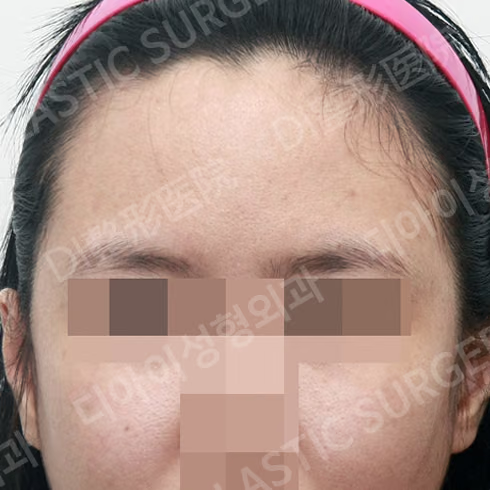
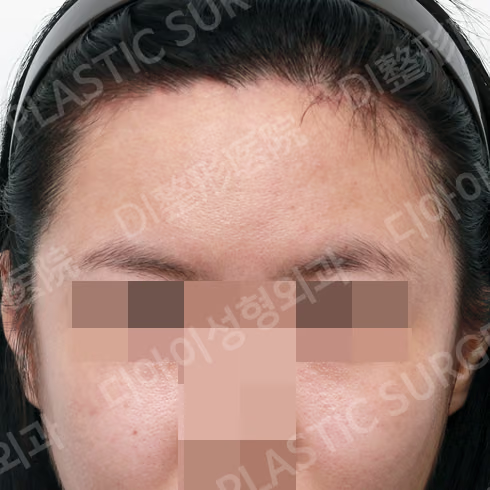
The unchanged pair below is designated gallery case 409, labelled Forehead reduction, Front, 1 month after surgery. This exact procedure label matches the topic. The gallery displays a relative postoperative interval, not calendar capture dates. It does not establish the patient’s incision design, reduction amount or exact operative technique; those details have not been inferred.
One case cannot predict your result or establish complete healing at one month. Individual results and recovery vary. The photographs retain their original composition and any original privacy masking, without generated retouching, cropping or added branding. The three explanatory illustrations elsewhere in this article are AI-generated and are not patient evidence.
Find case 409 in the designated original DI Before & After gallery
Leave consultation with a specific, revisable plan
A useful discussion should leave you able to describe the proposed hairline change, limits, incision, alternatives, risks, cost and follow-up responsibilities. Ask for time to consider unclear details. The examination may lead to a different proposal or a decision not to operate.
An initial general inquiry can state your concern, preferred language and possible Seoul dates. Do not send sensitive records through a general inquiry; ask how relevant clinical information should be shared when needed. Online guidance helps organize questions but does not replace an appropriate examination.
Information that helps us prepare a useful reply
When contacting the clinic, tell us the procedure or concern you would like to discuss, your preferred language, whether you have had related treatment before and the dates you could visit Seoul. International patients may also wish to include their arrival and departure dates so the team can explain when an in-person consultation and follow-up may fit into the trip.
Please do not send passport numbers, payment information or complete medical records through an initial website inquiry. A coordinator can explain which health information or photographs are relevant and how they should be shared. Online guidance is preliminary; suitability, technique and the final treatment plan are determined only after an appropriate medical assessment.
 Before
 After
After