
Start with the reason an area looks hollow
If you are researching facial fat grafting in Korea, the important first question is not how much fat to inject. Ask the surgeon to explain what is causing the appearance you want to change and whether adding volume would address it. Bring one or two specific concerns rather than a list of facial areas selected from photographs.
DI’s published Fat Grafting page describes transferring a person’s own harvested fat to facial areas lacking volume. This article focuses on the questions needed to assess that proposal; it does not establish that you need treatment or that every hollow-looking area should be filled. An online image cannot replace an examination.
Ask for a treatment-area plan, not a full-face label
DI discusses areas including the temples, front cheeks and nasolabial folds. Ask which, if any, are relevant to you, why each is proposed and what the surgeon would leave untreated. Have the proposed areas explained in relation to your existing facial proportions, previous treatments and goals.
A “full-face” label does not explain the extent of treatment. Request a distinction between the primary concern and optional additional areas. Ask whether a smaller plan, another approach or no procedure would be reasonable. You should be able to decline an optional component without losing the explanation of the rest of your care.
Remember that there is also a fat-harvest site
Unlike an injection-only product, fat transfer involves obtaining tissue from another area of your body. DI lists examples such as the abdomen and thighs. Confirm the proposed donor site after assessment rather than assuming you can choose it solely for convenience. Ask why it is suitable and whether previous surgery or another condition changes the plan.
Request separate instructions for the face and the harvest incision: dressing care, clothing, bathing, activity and whether any stitches need removal. A facial appointment may still require review of a body site. Ask whether harvesting is limited to collecting tissue for the transfer; do not assume it is equivalent to a separate body-contouring operation.
Get the anesthesia and discharge arrangements in writing. DI’s overview lists sedation, but your clinician must confirm the actual plan and the need for an accompanying adult. A short published procedure estimate is not a personal discharge or travel clearance.
Talk about retained volume and uncertainty
DI’s care information acknowledges that grafted volume can decrease depending on fat survival. Ask how the surgeon will explain early swelling, later volume change and the point at which reassessment is useful. Do not interpret the appearance immediately after treatment as the amount that will remain.
Ask what would happen if the result is uneven, less than you hoped for or more than you wanted. Is observation, another assessment or an additional procedure proposed, and what would that involve? A possible second session should not be described as inevitable, free or part of a guaranteed result unless the agreed quotation explicitly says so.
Using your own tissue does not guarantee predictable retention or eliminate complications. This article does not promise a survival percentage, a permanent contour or a fixed final-result date. Personal suitability, effects, price and recovery require individual evaluation.
Discuss important risks, including uncommon serious ones
Possible problems include infection, bleeding, asymmetry, lumps, fatty cysts, fat necrosis, persistent swelling, changes in sensation and an unsatisfactory donor-site appearance. Anesthesia and additional surgery also need discussion. ASPS lists rare blindness as a possible complication of facial fat transfer in its cheek-augmentation safety guidance. Ask how risks relate to the particular areas being considered and how the team handles a suspected complication.
This is not an exhaustive list or an estimate of your personal risk. Share prior facial injections or surgery, medical conditions, allergies, medicines, supplements and nicotine use with the treating clinician. Do not stop prescribed medication based on an article. Confirm who will perform the procedure and who will provide postoperative reviews.
Separate volume treatment from lifting and eye procedures
Adding volume and addressing loose tissue are different questions. If a recommendation combines fat grafting with a lifting procedure, ask what each component is intended to do and how the combination changes consent, cost and recovery. DI’s menu placement does not make fat grafting interchangeable with facelift surgery.
Under-eye fat repositioning is also a separately listed procedure. Do not use its case photographs, pricing or care schedule to decide on facial fat grafting. When your concern is around the eyes or loose skin, discuss the diagnosis and alternatives rather than treating every procedure name as a substitute.

Ask about two-site aftercare before arranging a Seoul visit
DI’s published care guidance discusses swelling, bathing, pressure on the treated area and habits during recovery. Ask the treating team which instructions apply to the actual technique and donor site in your plan. Do not improvise compresses, massage, dieting or exercise to try to improve retention.
Request the dates and purpose of follow-up reviews, who to contact outside clinic hours, and what symptoms need urgent assessment. Tell the clinic about tentative flights and any onward travel. An initial recovery estimate does not establish fitness to fly or mean that a short stay is suitable for you.
Discuss personal treatment and follow-up arrangements with DI
Understand what the original comparison can and cannot show
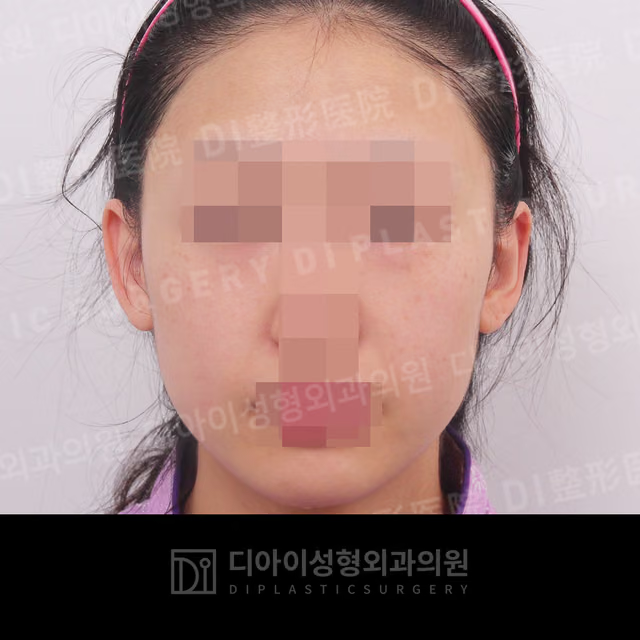
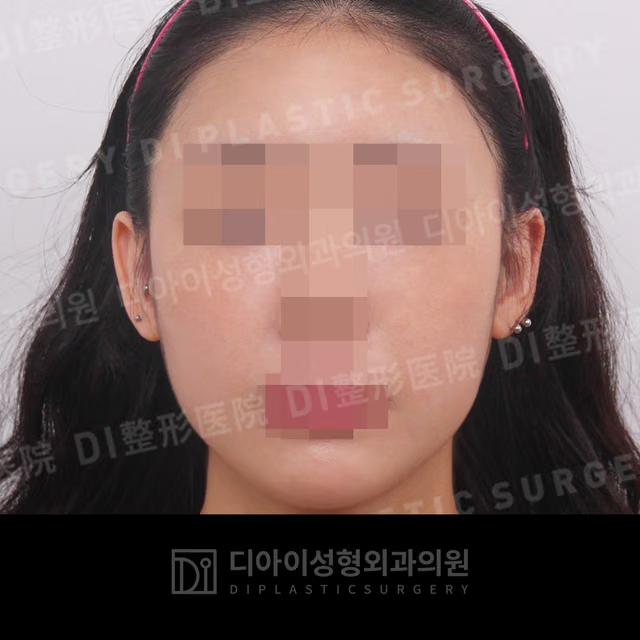
The original pair below is designated DI gallery case 031, labelled Fat grafting, Front, 1 month after surgery. Neither photograph has a displayed calendar capture date; the exact pretreatment interval, donor site, volume and technique are not shown. Those details have not been inferred.
The pair is reproduced unchanged with the original privacy masking and markings. One follow-up photograph is not proof of a final result or a predicted retention rate. Individual outcomes and recovery vary. The three other explanatory images are AI-generated and are not patient evidence.
View case 031 in the designated original Before & After gallery
Leave consultation with a decision you can explain
Before committing, you should be able to describe the concern being treated, the proposed facial and donor areas, alternatives, important risks and required reviews. Request an itemized quotation covering harvesting, transfer, anesthesia, follow-up and the terms for any additional treatment. Do not choose by an injected-volume figure or a generic online package alone.
For an initial inquiry, provide your main concern, preferred language and tentative visit dates. General questions can be answered before travel, but examination and informed consent may change the recommendation. Allow time to reconsider or decline treatment.
Information that helps us prepare a useful reply
When contacting the clinic, tell us the procedure or concern you would like to discuss, your preferred language, whether you have had related treatment before and the dates you could visit Seoul. International patients may also wish to include their arrival and departure dates so the team can explain when an in-person consultation and follow-up may fit into the trip.
Please do not send passport numbers, payment information or complete medical records through an initial website inquiry. A coordinator can explain which health information or photographs are relevant and how they should be shared. Online guidance is preliminary; suitability, technique and the final treatment plan are determined only after an appropriate medical assessment.
 Before
 After
After