
Start by identifying what creates the prominence
If you are considering cheekbone reduction in Korea, ask the surgeon to distinguish a bony prominence from the appearance produced by surrounding skin, muscle and fat. Describe the particular view that concerns you: the front, an angled view or the side. A photograph and a broad “small-face” label cannot establish that changing the cheekbone is appropriate.
DI’s official overview describes assessment of facial bones and soft tissues alongside overall proportions. This article focuses on the decisions that assessment should explain, rather than presenting a standard amount of reduction or a shape that everyone should seek. Suitability, effects, price and recovery require individual evaluation.
Ask which part of the cheekbone the proposal addresses
DI distinguishes lateral prominence at the zygomatic arch from prominence around the angled cheekbone area. Ask the surgeon to show which structures contribute to your concern and which would be changed. A plan addressing only one area is not automatically equivalent to a plan involving both the body and arch of the cheekbone.
Discuss the intended change in more than one view and the limits of that change. What contour would be preserved? How could existing asymmetry affect planning? Do not choose an operation by the largest promised reduction, a generic millimetre target or a photograph of another person. Ask whether observation or a different approach would better match your actual concern.
Understand the role and limits of imaging
DI’s page discusses 3D CT as part of facial-bone planning. Ask whether imaging is indicated for you, what it will answer and whether previous scans can be reviewed. Have the clinician explain the proposed assessment rather than assuming that every visitor needs the same scan.
Imaging and planning illustrations do not guarantee a result. The discussion should relate the bone assessment to the examination and the overlying tissues. Ask which conclusions are based on examination, which on imaging and which remain uncertain. A simulated outline is not a promise of your postoperative appearance.

Have the proposed bone movement and fixation explained
DI describes cutting and repositioning cheekbone segments through an incision inside the mouth, followed by fixation. Ask which incisions and bone changes are actually proposed in your case, whether any additional access is needed, and what material will hold the segments in place. Do not infer the details from a procedure name alone.
Ask how the team checks stability and healing, whether the fixation is intended to remain, and what findings might require further assessment. DI’s own explanation emphasizes fixation and discusses nonunion when cut segments do not join properly. A fixation method cannot be described as eliminating every risk of nonunion, hollowing or soft-tissue change.
A surgical explanation should be understandable without requiring you to interpret a CT scan or learn operative technique. Request a written summary of the proposed approach and alternatives before deciding.
Discuss soft-tissue changes and other meaningful risks
Reducing bone prominence does not establish how the overlying cheek will look. Ask about the possibility of soft-tissue drooping or hollowing, especially when there is already a concern about loose tissue. Bone reduction and lifting are separate decisions; do not assume that one automatically replaces the other.
A published meta-analysis of intraoral reduction malarplasty reports sensory changes, drooping, nonunion, asymmetry, restricted mouth opening, bleeding and facial-nerve injury among the complications studied. These historical research findings are not DI complication rates or a personal risk estimate. Infection, pain, swelling and anesthesia-related risks also need discussion with your clinicians.
Share prior facial surgery or injections, dental concerns, medical conditions, allergies, medicines, supplements and nicotine use with the treating team. Do not stop prescribed medicine based on a web article. Confirm the operating surgeon and the anesthesia and emergency arrangements for your actual plan.
Keep related procedures separate in the decision
If the consultation proposes jaw or chin surgery as well, ask what each additional procedure is intended to address. A combined “facial contouring” label does not explain the separate changes, risks or follow-up requirements. You can ask for an explanation of the cheekbone-only option and decline optional treatment.
Facial liposuction addresses a different treatment question from repositioning bone. Likewise, adding volume or lifting soft tissue is not the same as cheekbone reduction. Consider these only when the assessment explains why they are relevant, not because they appear together on a menu.

Ask for a personal mouth-care and follow-up plan
DI’s care information discusses diet, cleaning around an incision inside the mouth, swelling and protection from pressure or impact. Before treatment, ask for written instructions covering food texture, rinsing, toothbrushing, medicines and activity. Do not copy a product, dilution or timetable from a general page into your own care without the team’s confirmation.
Request the required review dates, what will be examined, and how concerns about sensation, mouth opening or healing will be assessed. Ask what symptoms require urgent local care and who can be contacted outside clinic hours. The published page contains different overview and technique-specific time estimates; these are not a personal operating time, discharge promise or travel-clearance date.
Read the original six-month pair in its proper context
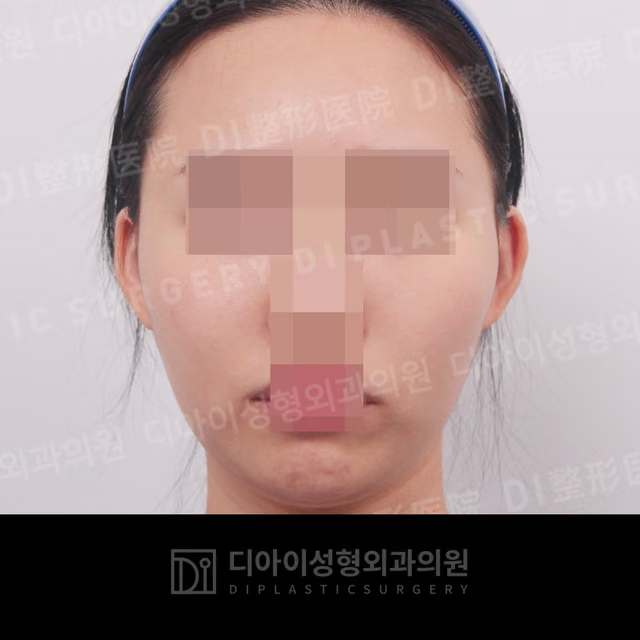
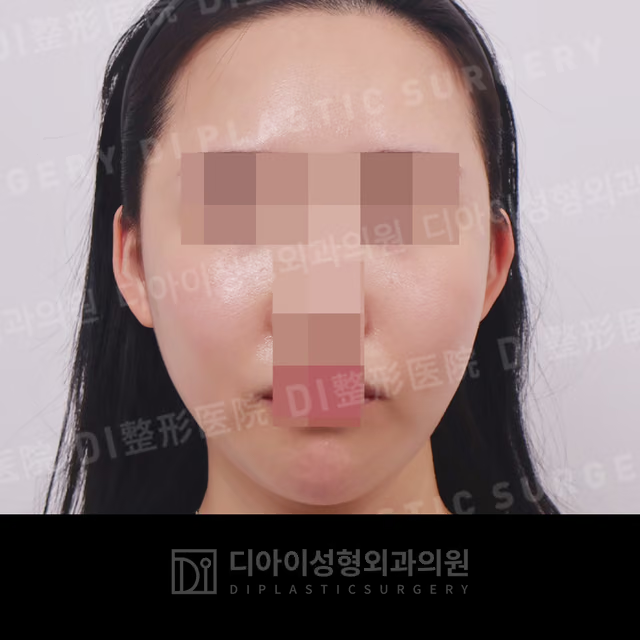
The unchanged photographs below are designated DI gallery case 014, labelled Cheekbone reduction, Front, 6 months after surgery. No calendar capture dates, pretreatment interval, operative detail or fixation type are displayed. Those details have not been inferred.
This is a single case, not a prediction of your result or proof that everyone heals on a six-month schedule. The original privacy masking and markings are retained. Individual results and recovery vary. The three explanatory images in this article are AI-generated and are not patient evidence.
Leave consultation with a plan you can evaluate
Before arranging surgery, you should be able to explain what is being changed, why that change is proposed, which limits remain, and how postoperative care will be reviewed. Request an itemized quotation that distinguishes surgery, anesthesia, examinations, follow-up and any additional treatment or travel costs.
For an initial inquiry, provide your main concern, preferred language and tentative Seoul dates. Allow time for an examination and a decision without assuming that an available appointment commits you to surgery. A bone-healing plan and a travel itinerary should be coordinated by your treating team; an initial recovery estimate alone is not clearance to fly.
Information that helps us prepare a useful reply
When contacting the clinic, tell us the procedure or concern you would like to discuss, your preferred language, whether you have had related treatment before and the dates you could visit Seoul. International patients may also wish to include their arrival and departure dates so the team can explain when an in-person consultation and follow-up may fit into the trip.
Please do not send passport numbers, payment information or complete medical records through an initial website inquiry. A coordinator can explain which health information or photographs are relevant and how they should be shared. Online guidance is preliminary; suitability, technique and the final treatment plan are determined only after an appropriate medical assessment.
 Before
 After
After