
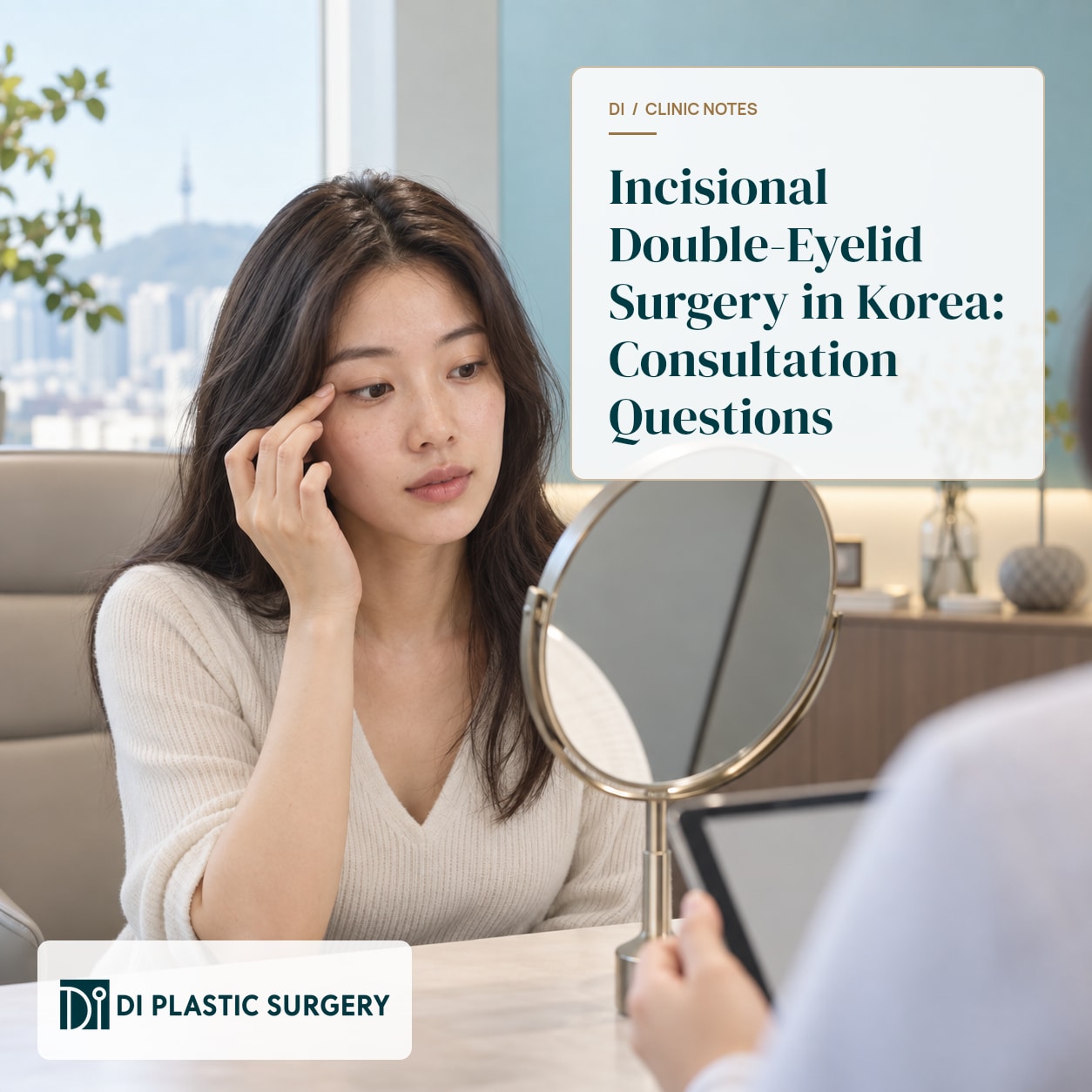
What “incisional” means—and what it does not tell you
DI Plastic Surgery lists incisional double-eyelid surgery among its eye procedures. An incisional approach creates access through an eyelid incision to form or adjust an upper-lid crease. The label alone does not tell you the exact incision, tissue work, anesthesia, crease height or whether another concern, such as eyelid opening, needs separate assessment. Those decisions belong to an examination and a discussion with the surgeon.
This article is a guide to questions, not a recommendation to have surgery. Bring photographs of your own eyelids in a relaxed expression, and explain what bothers you without assuming that a reference photograph can be reproduced. A surgeon should consider both appearance and eye function before proposing a plan.
Ask why this method is being considered
DI also describes natural-adhesion and other double-eyelid options. Ask what your eyelid anatomy suggests about each approach, what each can and cannot change, and why an incisional method is being discussed for you. Do not treat incisional and non-incisional labels as interchangeable promises about permanence or recovery.
Discuss any previous eyelid procedure, asymmetry, contact-lens use, dry-eye symptoms, trouble fully closing the eyes, or changes in vision. Tell the team about medications, supplements, smoking and relevant medical conditions. The American Society of Plastic Surgeons recommends reviewing goals, health history, previous operations, medications, treatment options and risks during an eyelid-surgery consultation.
Talk about the crease, scar and eye function together
Ask where the proposed crease would sit when your eyes are open and closed, how much difference between sides is realistic, and where a visible scar might remain. Swelling and individual healing can affect an early appearance. A consultation should address the limitations of photographs and the possibility that the final contour differs from a sample image.
Ask whether the plan includes any additional skin, muscle or fat work, or an assessment of eyelid opening. Such steps are not automatic components of every incisional procedure. The ASPS describes an upper-eyelid incision placed within the natural crease in general blepharoplasty information; this is not a statement of the specific method DI would use for you.
Review risks and the care plan before agreeing
Eyelid surgery carries potential risks. General patient information lists bleeding, infection, anesthesia-related problems, dry eyes, difficulty closing the eyes, asymmetry, scarring and the possibility of further treatment. Ask which risks are relevant to your proposed operation and medical history, how symptoms are monitored, and who to contact if an unexpected problem occurs.
Get the proposed technique, anesthesia plan, follow-up visits and postoperative instructions in writing. Ask what symptoms require urgent medical assessment rather than a routine message. No online article or illustrative image can establish your personal risk or guarantee a result.
Plan Seoul travel around follow-up, not a fixed “recovery day”
Before booking a return flight, ask when an in-person review is expected, whether stitches or dressings may need attention, and which activity restrictions apply. Bruising and swelling can change over time; work, exercise and flight readiness are individual decisions for your treating team. An online inquiry can help organize dates, but it cannot replace the preoperative examination or confirm a safe departure date.
If traveling internationally, keep accommodation flexible and ask how you will obtain help after clinic hours and after returning home. Share your preferred language and any previous surgical records early. Request a written estimate that distinguishes the proposed operation from consultation, tests, anesthesia, medicines and follow-up; final cost depends on the individual plan.

A concise consultation checklist
Why is an incisional method being considered instead of natural adhesion or no surgery? Where will the crease and incision be, and what scar may remain? Is eyelid opening or ocular-surface health part of the assessment? What are the alternatives and limits? Who provides anesthesia? What complications should prompt an urgent call, and how are they handled?
How many in-person reviews are planned before I leave Seoul? What does the quote include, and what could change it? Review DI’s procedure information, the medical-team profile and the consultation guide, then use these questions with your surgeon. Candidacy, technique, results, price and recovery require an individual medical assessment.
Information that helps us prepare a useful reply
When contacting the clinic, tell us the procedure or concern you would like to discuss, your preferred language, whether you have had related treatment before and the dates you could visit Seoul. International patients may also wish to include their arrival and departure dates so the team can explain when an in-person consultation and follow-up may fit into the trip.
Please do not send passport numbers, payment information or complete medical records through an initial website inquiry. A coordinator can explain which health information or photographs are relevant and how they should be shared. Online guidance is preliminary; suitability, technique and the final treatment plan are determined only after an appropriate medical assessment.
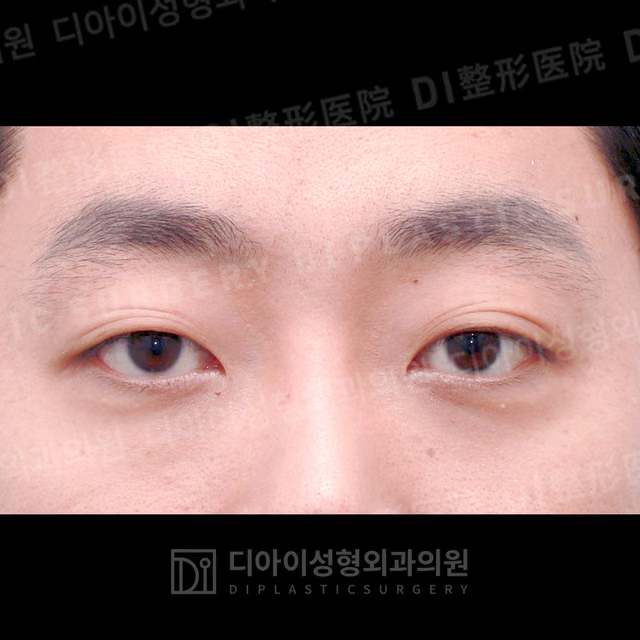 Before
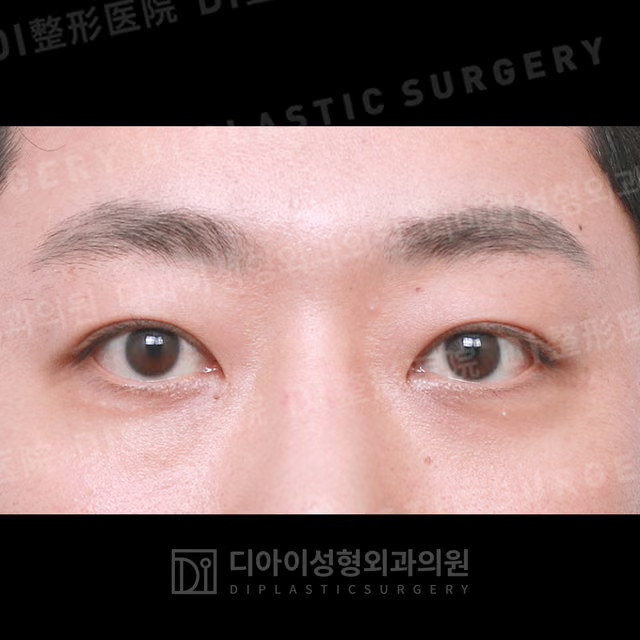 After
After