
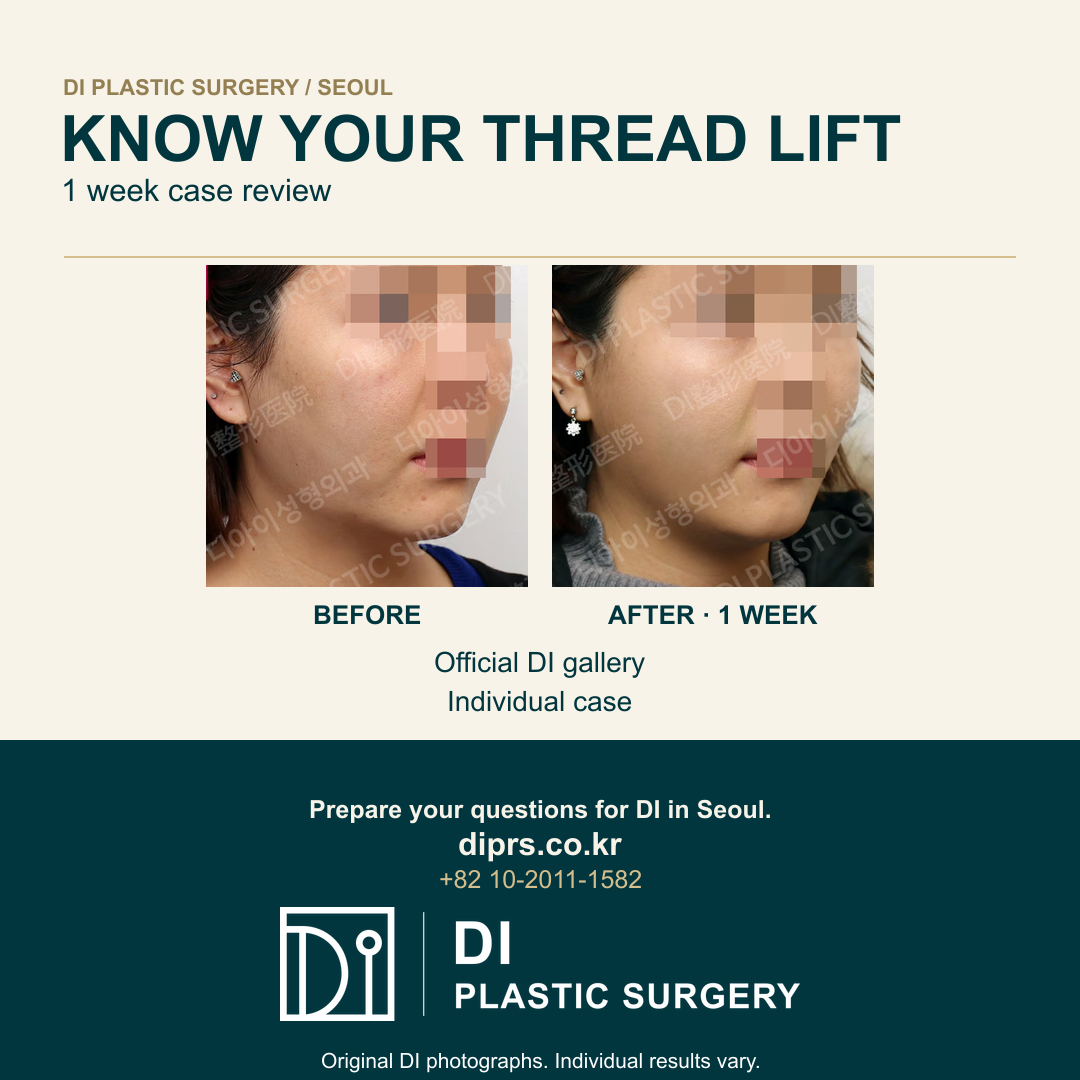
Read the one-week label without adding a promise
DI’s official gallery identifies case 037 as a thread lift, photographed at one week. The original oblique-view pair and privacy masking are preserved. This is an individual case, not a forecast of how much lift another person will have, a guarantee of symmetry, or evidence that no aftercare remains. Individual results vary.
The gallery label does not identify thread composition, brand, count, insertion technique or expected duration. Do not infer those details from the picture or borrow them from a different clinic’s page. Put the missing information on your consultation checklist and ask which records you would receive if treatment were proposed.
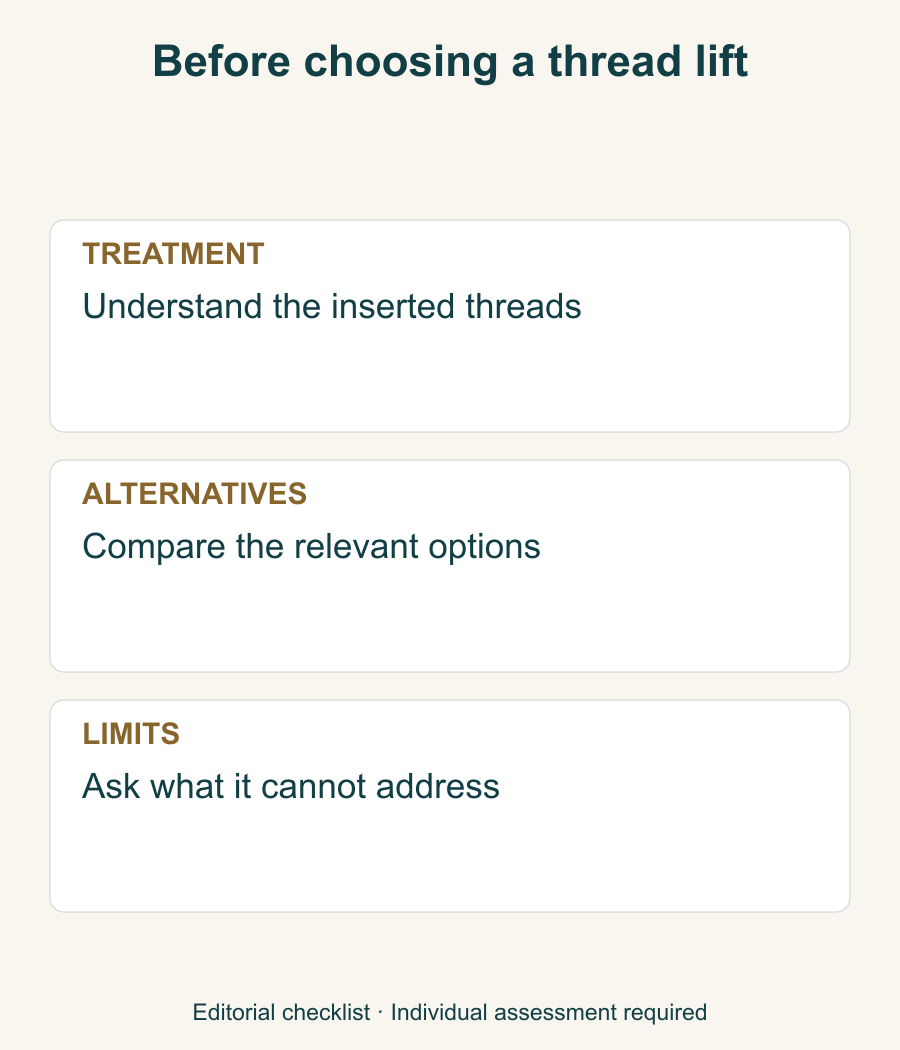
Distinguish the treatment from its alternatives
ASPS describes thread lifting as a minimally invasive treatment involving sutures placed in tissue. Discuss what a thread-based approach is intended to address and what its limitations are for your particular concern. The word nonsurgical does not mean that nothing is inserted, that it is risk-free or that it is equivalent to a facelift.
Ask the clinician to compare relevant alternatives without choosing solely from photographs: whether an operation, a different nonsurgical treatment or no intervention is more appropriate. An ultrasound entry in the price guide is a different treatment category; it should not be treated as another name for thread lifting or combined into an unspecified package.
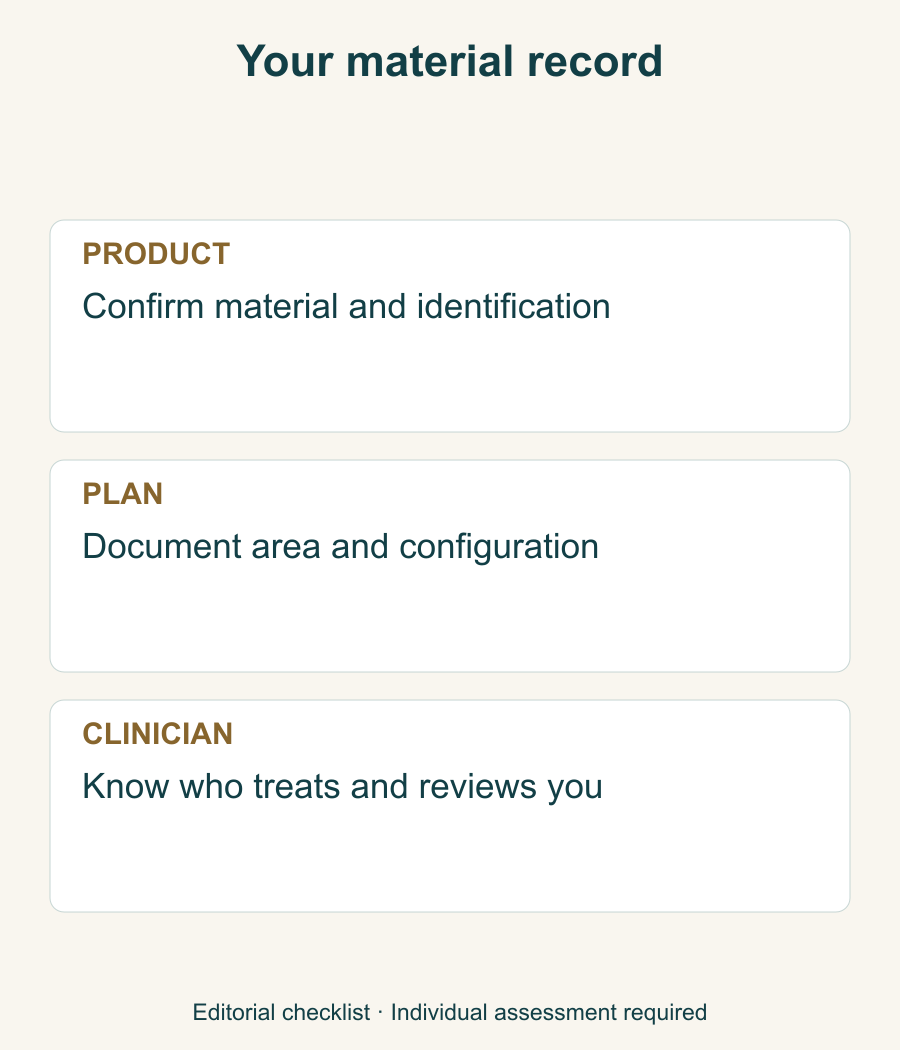
Ask for a material and scope record
A practical record has three parts. First, the proposed material and product identification. Second, the planned treatment area and thread configuration. Third, the name of the treating clinician and the follow-up route. Ask which details can be documented and which decisions depend on the examination.
DI’s September 2026 schedule lists a 4 + 4 thread entry and a separate 2 + 2 thread add-on. Those are pricing labels, not evidence that a particular count is right for you, that every type of thread is included or that the two charges should automatically be combined. Confirm the current product, plan and itemized quotation.
Discuss risks before judging convenience
ASPS lists potential issues including infection, persistent pain, thread extrusion, bruising or swelling, difficulty opening the mouth and an unfavorable result. Ask what these terms mean in the proposed plan, how a problem would be assessed and who would manage it. A brief treatment description is not enough to establish personal suitability.
Do not pull, trim or otherwise manipulate an area because a thread seems visible or uncomfortable. Contact the treating clinical team for assessment and ask beforehand which concerns need prompt contact or urgent local care. This page does not diagnose a symptom, identify a thread type from an image or give a self-treatment protocol.
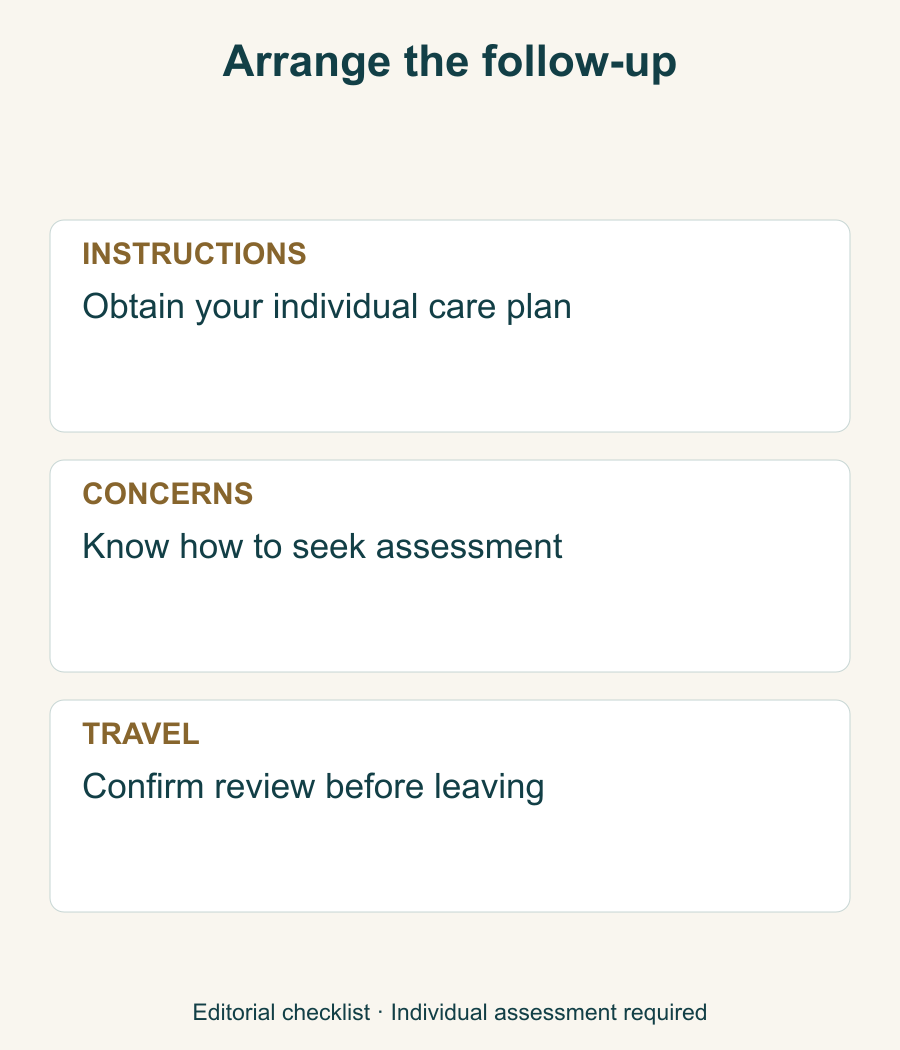
Plan follow-up before arranging travel
The ASPS recovery page emphasizes individualized instructions, medication or skin-care directions when prescribed, concerns to watch for and follow-up timing. Ask what applies to your face, which activities are restricted and who will reassess you. A one-week gallery photograph cannot serve as permission to exercise, massage the face or leave without an agreed plan.
If you are visiting Seoul, separate the consultation appointment from the treatment decision and subsequent review. Confirm the clinic’s current fees, availability, language arrangements, follow-up responsibility and how to contact the team after leaving Korea. Sending an inquiry does not confirm an appointment, a treatment or a fixed price.
Source limits and editorial responsibility
The DI gallery supplies the actual case label, angle and one-week interval. The ASPS sources explain the general procedure category, risks and recovery questions. They do not verify the particular thread product used in case 037, establish durability for this patient or imply an affiliation between ASPS and DI.
Prepared as an editorial guide on 29 October 2026, without a new physician-review claim. The full price guide and DI medical-team information can help you prepare questions, while the treating clinician remains responsible for individual assessment and treatment advice.
Information that helps us prepare a useful reply
When contacting the clinic, tell us the procedure or concern you would like to discuss, your preferred language, whether you have had related treatment before and the dates you could visit Seoul. International patients may also wish to include their arrival and departure dates so the team can explain when an in-person consultation and follow-up may fit into the trip.
Please do not send passport numbers, payment information or complete medical records through an initial website inquiry. A coordinator can explain which health information or photographs are relevant and how they should be shared. Online guidance is preliminary; suitability, technique and the final treatment plan are determined only after an appropriate medical assessment.