
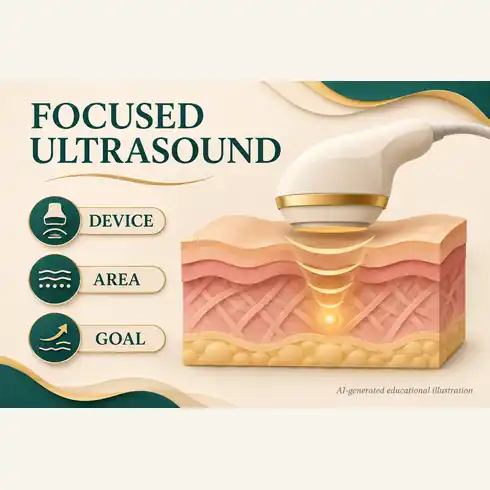
What is focused ultrasound skin tightening?
Focused ultrasound devices concentrate acoustic energy in tissue. Certain systems use localized heating to produce a tissue effect intended to change appearance. Ultrasound is a different technology from laser or radiofrequency, even though these treatments may appear together on a cosmetic clinic menu. A treatment name does not identify every feature of the proposed system.
The American Academy of Dermatology describes noninvasive ultrasound tightening as an option that can produce modest, gradual lifting for appropriately selected people. This is general patient guidance, not a promise for every device or patient. It does not establish that ultrasound can reproduce a surgical facelift or that the same approach suits every concern.
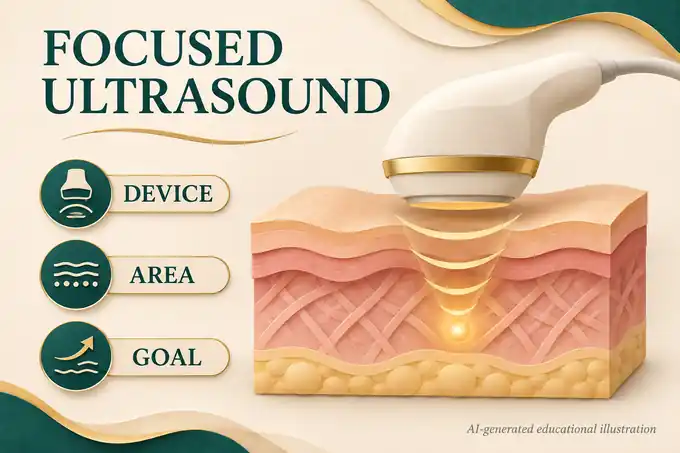
What does DI list, and what remains to be confirmed?
DI’s published schedule contains Shurink HIFU lifting in 100-shot and 300-shot entries. These are catalogue options rather than a recommendation to purchase one particular count. Ask DI to confirm the exact model, intended treatment area and current availability before you arrange travel. The published name alone does not verify the model, imaging capabilities or every device indication.
Discuss whether your main concern is skin laxity, volume distribution, a crease, or another finding that needs assessment. These are different questions. The clinician should explain why focused ultrasound is relevant, what it cannot address, and whether another assessment, another approach or no treatment would be preferable.
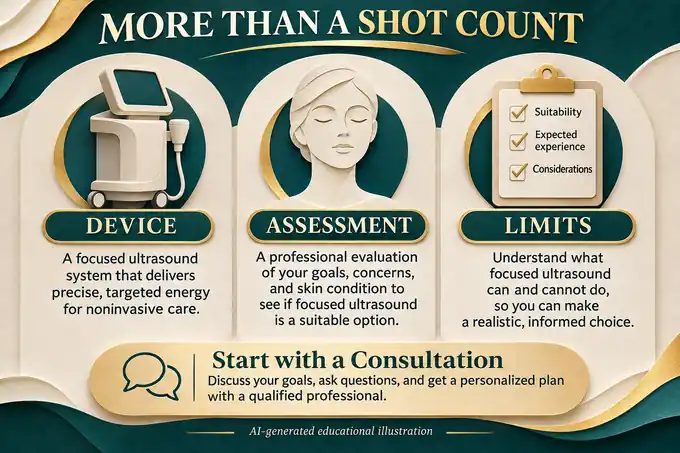
Why a shot count cannot decide the plan
A count describes part of the quoted service. It does not show the assessed area, chosen device, tissue characteristics or the clinician’s safety plan. Do not assume that a larger number is automatically more suitable, or that two clinics quoting the same count provide an identical treatment.
Ask for the proposed area and scope in writing. If the recommendation changes after assessment, ask why and request an updated estimate before deciding. This article does not provide treatment depths, energy settings, cartridge selection or a map for applying a device. Those are clinical decisions for the trained treating professional.
| Compare this | Ask the clinician |
|---|---|
| Actual device | Which model would be used and why is it appropriate? |
| Area and goal | What concern and area does this quotation cover? |
| Count and scope | What does the count represent in this individual plan? |
| Limits and alternatives | What is unlikely to change, and what other choices exist? |
Evidence and safety require device-specific questions
The FDA’s focused-ultrasound guidance identifies thermal and mechanical injury, ocular injury, electrical shock, inflammation or foreign-body response, and use error among risks to be addressed for the device class. This US regulatory guidance explains safety considerations; it is not evidence of Korean authorization or FDA clearance for a particular DI device.
AAD’s discussion of modest tightening is also not a device-specific prediction. Ask which clinical evidence relates to the proposed model and your concern, how the response would be assessed and what uncertainty remains. A generic illustration of sound waves does not establish the depth or effects of your actual treatment.
What history should you bring?
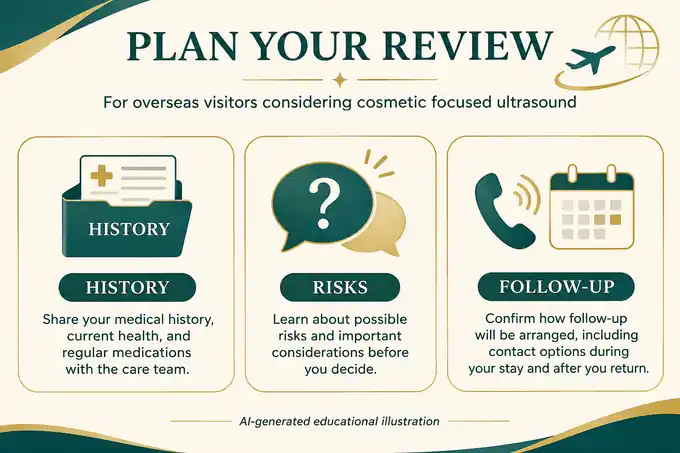
Tell the clinician about previous cosmetic procedures, implants or implanted devices, current medicines, skin problems, pregnancy, allergies and prior unwanted reactions. FDA guidance discusses wounds or lesions, active implanted devices and metallic implants as areas requiring contraindication information. Your own clinician must apply the actual device labeling and your history to decide suitability.
Ask about discomfort, redness or swelling and about symptoms that should prompt contact or an urgent assessment. Clarify who performs the procedure, how concerns are handled and how review works after you return home. Do not stop prescription medicine or arrange repeated sessions based on a general blog.
How to read the published Shurink price
The price schedule dated 11 September 2026 lists entry di-169, Shurink HIFU lifting—100 shots, at KRW 120,000, and di-170, 300 shots, at KRW 300,000. The website states that VAT is excluded. These are dated reference amounts; confirm the current price, actual scope and suitability with DI. They do not establish a full-face package or an individual final quotation.
Ask whether consultation, pain-management measures, additional areas, medicines and follow-up have separate charges. Compare the same device and assessed scope when comparing quotations. A lower headline amount cannot answer whether the proposed treatment addresses your particular concern safely.
Plan your visit and review before booking travel
DI is at 12F, Seosan Building, 441 Gangnam-daero, Seocho-gu, Seoul, near Gangnam Station. Confirm appointment availability, language or interpreter arrangements and consultation fees before travelling. An online inquiry does not confirm that treatment can take place on arrival day.
Request understandable written care instructions, a contact route and a review plan. Discuss planned activities, other cosmetic procedures and your return trip with the treating team. There is no universal treatment, repeat-session or flight timetable in this guide. Editorial sources checked 3 November 2026; this is not a new clinician review. All illustrations are AI-generated education rather than clinical evidence. #DIPlasticSurgery #HIFU #Seoul
Information that helps us prepare a useful reply
When contacting the clinic, tell us the procedure or concern you would like to discuss, your preferred language, whether you have had related treatment before and the dates you could visit Seoul. International patients may also wish to include their arrival and departure dates so the team can explain when an in-person consultation and follow-up may fit into the trip.
Please do not send passport numbers, payment information or complete medical records through an initial website inquiry. A coordinator can explain which health information or photographs are relevant and how they should be shared. Online guidance is preliminary; suitability, technique and the final treatment plan are determined only after an appropriate medical assessment.